
Insights
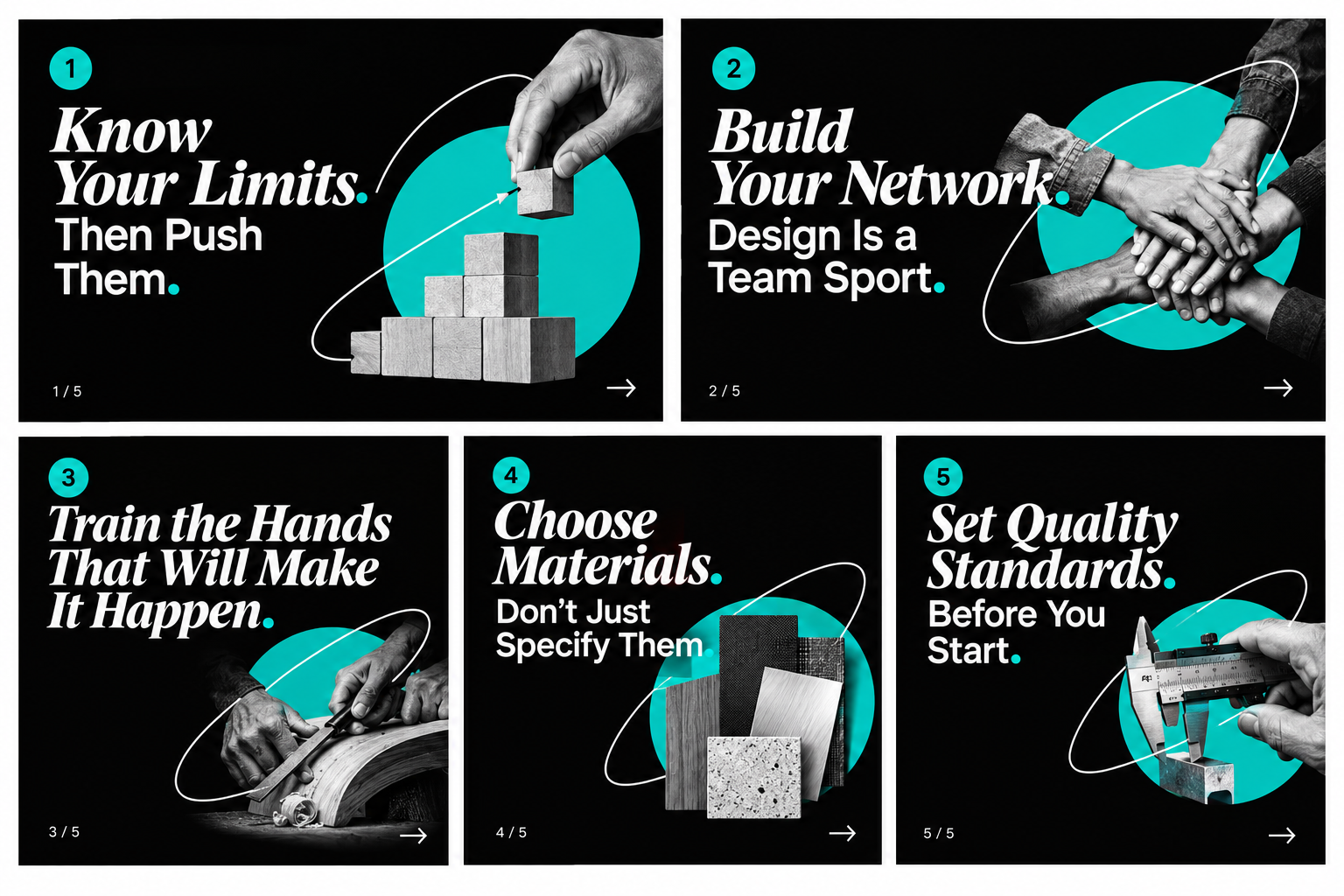
Great ideas need great execution to realise their full potential.Constraints can sharpen creativity when understood and challenged.The right collaborators can unlock possibilities beyond the drawing board.Training the people who make a design is part of designing it.Material choices shape performance, perception and experience.Clear quality standards turn design intent into consistent outcomes.
🔊 Listen to this article!
The bane of a designer and the making of great design
It takes a village to raise a child. The same can be said about bringing a design to life.A great idea is only the beginning. There lies a long, often unpredictable journey between the moment a designer visualises a solution and the moment it reaches a consumer. It involves materials, manufacturing processes, engineering, craftsmanship, suppliers, budgets, deadlines and, above all, people. Each has the potential to make the design better or compromise it. British designer Sir Terence Conran famously observed that good design is largely common sense, with functionality demanding time and attention. While the precise proportions may be debatable, the sentiment holds true. The magic of design is not merely in conceiving an idea, but in getting every detail right when it is realised. That is where the pudding is proved. A beautifully rendered concept can become an ordinary product. A promising prototype can turn into a manufacturing nightmare. A carefully considered identity can lose its character in printing. And a seemingly minor material substitution can change how a product looks, feels, performs and is perceived. Execution is often the bane of a designer’s life because it is where creative intent meets practical reality. It is also where design earns its worth. Here are five tenets that can help designers, design managers, product managers and business leaders bridge the gap between a good idea and a great outcome. 1. Know Your Limits. Then Push Them.
Nobody asks a designer to stay within the lines. Breaking the mould is, after all, part of the job. But creative freedom without an understanding of context can produce solutions that are impractical, unaffordable or simply impossible to realise. Is the design a one-off installation or a product that must be manufactured a million times? Is it meant for a premium market or an aggressively competitive price point? What technologies, skills, materials and production facilities are available? How much time is there before launch? These are not questions that restrict creativity. They define the playing field on which creativity must perform. Think of IKEA. Its flat-pack furniture system is an iconic example of designing within constraints. Packaging dimensions, transportation costs, assembly and affordability are integral to the design proposition. The result is furniture that looks good, yes, but it is furniture designed around the realities of making, moving and selling at scale. The lesson is not to accept every constraint unquestioningly. It is to understand which ones are non-negotiable, which can be challenged and which might even inspire a better solution. A designer who understands the boundaries can push them intelligently. One who ignores them may end up designing something wonderful that nobody can make. 2. Build Your Network. Design Is a Team Sport.
A good designer working alone is rarely enough. A poster may need a type specialist, a copywriter and a master printer. A chair may depend on a carpenter’s understanding of joinery. An appliance may require the combined expertise of industrial designers, engineers, toolmakers, material specialists and manufacturing teams. The designer’s job is not to know everything. It is to know what needs to be known, who knows it and when to bring that expertise into the process. Consider the original Apple Macintosh. Its success was not because they designed an attractive computer enclosure, or the innovative graphical interface. It emerged from the integration of hardware, software, typography, industrial design and human-computer interaction into a coherent experience. Consider ISRO’s Chandrayaan-3 mission. Its successful lunar landing was the result of numerous scientific, engineering, software, systems-integration and operational teams working towards a common objective. No single discipline could have delivered the mission independently. The performance of the whole depended on the coordination and reliability of its many parts. This is the value of a strong design ecosystem. The right collaborator or, an experienced craftsperson or supplier can reveal possibilities that were never apparent on the drawing board. Build relationships with people who understand materials, processes, technology and production. Involve them early, learn from them, share with them about the design when the design is not yet frozen. The stronger the network, the greater the possibility of turning an ambitious idea into an exceptional outcome. 3. Train the Hands That Will Make It Happen.
Designers are expected to push boundaries. But when a design introduces a new detail, process or technique, the people responsible for making it may not automatically know how to execute it with perfection. A detail that looks effortless in a rendering may require a new tool, an unfamiliar assembly sequence or a different level of craftsmanship. Assuming that everyone will simply figure it out is a recipe for disappointment. Sometimes, the designer must demonstrate the technique, make the first sample, develop a jig, prepare a reference piece or work alongside the production team until the desired result becomes repeatable. The Eames Lounge Chair and Ottoman, designed by Charles and Ray Eames, offer a compelling example. Its distinctive form depends on the considered relationship between moulded plywood shells, upholstery, cushioning and carefully engineered assembly. The visual elegance is inseparable from the processes and expertise required to manufacture it consistently.The broader lesson applies well beyond furniture. Whether it is a precision-moulded product, a complex package, a retail fixture or a digital interface, the team responsible for execution needs to understand not just what to make, but how and why it must be built that way. Training is essentially an extension of the design process. Plus, there is a bonus. The people who actually produce the work often spot practical improvements that a designer may have overlooked. Demonstration and collaboration create a feedback loop that improves both the outcome and the process. 4. Choose Materials. Don’t Just Specify Them.
There is a constant dance between a designer’s imagination and the way colour, material and finish come together in the real world. Yet material selection is often treated as a finishing exercise, something to be resolved after the form has been approved. This can be a costly mistake. Materials determine far more than appearance. They influence strength, weight, durability, tactile experience, manufacturing complexity, cost, maintenance, sustainability and even the way a product ages. The same design can communicate quality or cheapness depending on the material, finish and precision of execution. A colour that looks perfect on a screen may behave differently on a textured surface. A glossy finish may reveal surface imperfections that a matte finish conceals. A substitute material may change not only the appearance but also the product’s performance. Dyson’s bagless vacuum cleaners demonstrate how material and engineering choices contribute to a distinctive product proposition. Their transparent dust-collection components make the technology visible, turning a functional feature into part of the product’s identity. The material communicates how the product works. Good material selection therefore requires more than a swatch book and aesthetic judgement. It requires samples, testing, supplier discussions and an understanding of the conditions in which the product will be manufactured, used and maintained. Choose materials for the experience you want to create, the performance you need to deliver and the realities of production. The right material makes the design possible. 5. Set Quality Standards Before You Start.
Last, but certainly not least, decide what good looks like, and make sure everyone else agrees. Quality cannot be left to individual interpretation. What appears acceptable to a designer may be considered too expensive by procurement, too difficult to manufacture by a supplier or be too inconsistent for a customer. The lead designer must translate the design intent into clear, measurable and agreed standards. These may include fits and tolerances, alignment of components, surface continuity, colour consistency, texture, strength, weight, dimensions, legibility, visibility, performance, durability and safety. For digital products, they may include responsiveness, accessibility, usability and consistency across devices. The benchmarks must reflect the intended performance, price point and market segment. A premium product and an entry-level product need not have identical specifications, but both must meet their intended promise. Toyota’s approach to quality and its Toyota Production System provide one powerful illustration. Standardised work, built-in quality and the practice of identifying problems rather than passing them downstream help make quality a repeatable organisational responsibility. Amul’s dairy ecosystem offers a useful Indian illustration of quality at scale. Its cooperative model connects a vast network of milk producers with collection, processing, distribution and quality-control systems. Design teams can apply the same principle. Establish reference samples, approved specifications, prototypes, testing criteria and sign-off stages before design and production begins. They agree on who checks what, when deviations are acceptable and who has the authority to approve them. When standards are clear, the process has a destination. Without them, everyone may work hard and still deliver different interpretations of the same design. The objective is to eliminate the avoidable surprises.The Final Word
Design Is Only as Good as Its Realisation. Design is often celebrated through the big idea, the clever sketch or the beautiful presentation. These are important, but they are not the final measure of success. The real test comes when the product is held, the package is opened, the space is experienced, the interface is used or the service is delivered. Does it work as intended? Does it feel right? Does it deliver the promised experience? Can it be made consistently, at the right cost, for the people it is meant to serve? Good design is seamless, appropriate, reliable and elegant. These qualities do not emerge from the concept alone. They are earned through hundreds of decisions made during realisation. For young designers, the takeaway is simple. Learn to love the making as much as the imagining. Spend time with factories, fabricators, printers, programmers and suppliers. Understand processes. Make prototypes. Test assumptions. Learn from failures. For designers, design managers and project managers, execution deserves the same attention as ideation. Build multidisciplinary teams, involve manufacturing and technical experts early, and create clear quality checkpoints. For CEOs and business leaders, remember that design investment does not end when a concept is approved. Underfunded prototyping, rushed tooling, late material changes and compromised quality can destroy the value created upstream. And for all of us, here is a useful question to ask before signing off a design: Have we merely approved a good idea, or have we created the conditions to make it great?Because, ultimately, God may lie in the details. But in design, God lies in execution. 










God lies in execution